Pruning apple trees improves tree structure, increases fruit quality, and helps prevent diseases by removing unnecessary or unhealthy growth. A well-pruned apple tree receives more sunlight, maintains better air circulation, and directs more energy toward producing healthy fruit instead of excessive branches. Regular pruning also makes harvesting, spraying, and routine maintenance easier throughout the growing season.
Many home gardeners hesitate to prune because they worry about removing the wrong branches or reducing the next harvest. In reality, most apple trees respond well to proper pruning. Removing dead, diseased, crossing, and overcrowded branches encourages stronger new growth while creating a balanced canopy that supports consistent fruit production. The timing, amount of wood removed, and the location of each cut all influence how the tree grows during the following season.
This guide explains how to prune apple trees step by step, from choosing the best pruning season and preparing the right tools to identifying which branches should be removed first. You’ll also learn how pruning techniques differ for young, mature, and overgrown apple trees, along with the most common mistakes to avoid. By following these practical recommendations, you can maintain healthier trees, improve fruit yield, and build a strong framework that supports productive harvests for many years.
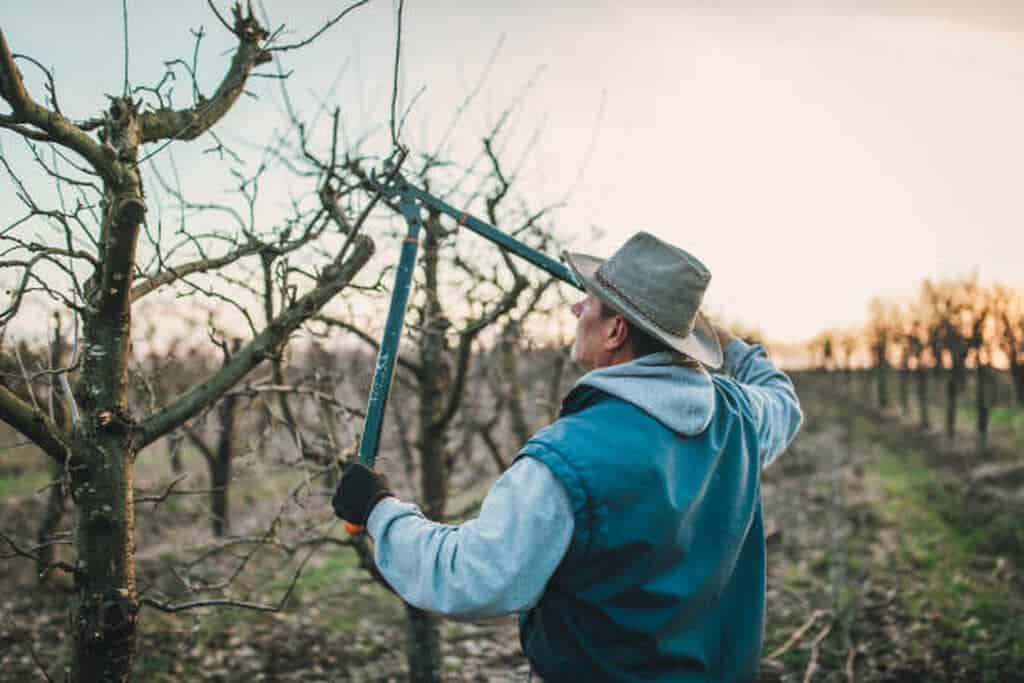
What is apple tree pruning?
Apple tree pruning is the process of selectively removing branches to improve the tree’s structure, health, and fruit production. Rather than reducing the tree’s size alone, pruning directs the tree’s energy toward productive growth while maintaining a canopy that receives adequate sunlight and airflow. Every pruning cut influences how the tree grows during the following season, making proper technique just as important as timing.
A well-pruned apple tree develops a strong framework of permanent scaffold branches that support heavy fruit loads without becoming overcrowded. Removing weak, damaged, or poorly positioned branches allows light to reach the interior of the canopy, where fruit buds can develop more evenly. Better air circulation also helps leaves and fruit dry faster after rain, reducing conditions that favor fungal diseases.
Regular pruning provides several measurable benefits for both the tree and the gardener. It improves fruit size and quality by reducing competition among branches, lowers the risk of broken limbs caused by excessive weight, simplifies harvesting, and makes routine tasks such as spraying, thinning fruit, and inspecting for pests much easier. Mature apple trees that receive annual maintenance pruning generally require fewer corrective cuts than neglected trees that have become dense and overgrown.
Not every branch should be removed. Productive pruning focuses on eliminating dead wood, diseased limbs, crossing branches, inward-growing shoots, water sprouts, and suckers while preserving healthy fruiting wood. The objective is to create a balanced canopy where sunlight reaches most branches without exposing the tree to excessive stress from over-pruning.
When is the best time to prune apple trees?
Late winter, while the tree is dormant, is the best time to prune most apple trees. During dormancy, the branch structure is easy to see because leaves have fallen, pruning wounds heal efficiently as growth resumes in spring, and the tree experiences less physiological stress than during active growth.
Winter pruning also stimulates vigorous new shoot development. For that reason, it is commonly used to establish the framework of young trees, renew older trees, and encourage stronger vegetative growth where needed. In most temperate climates, pruning is carried out from late winter until just before buds begin to break in early spring. Avoid pruning during periods of severe freezing temperatures because freshly cut wood can be damaged before healing begins.
Summer pruning serves a different purpose. Instead of encouraging vigorous growth, it helps control tree size, removes fast-growing water sprouts, and increases sunlight penetration into the canopy. This additional light improves fruit color, supports flower bud formation for the following season, and prevents the canopy from becoming excessively dense. Summer pruning is generally lighter than winter pruning because removing too much foliage can reduce the tree’s ability to produce energy.
Avoid pruning immediately before or during periods of prolonged wet weather whenever possible. Fresh pruning wounds are more vulnerable to disease-causing pathogens under consistently wet conditions. Trees that are severely stressed by drought, major pest infestations, or significant disease should also be assessed before extensive pruning. In these situations, restoring tree health first often produces better long-term results than making heavy structural cuts.
What tools do you need to prune apple trees?
Using the right pruning tools produces cleaner cuts, reduces damage to healthy wood, and lowers the risk of spreading disease. Each tool is designed for a specific branch size, so selecting the correct one makes pruning safer and more efficient.
There are 4 essential pruning tools for most home gardeners:
- Hand pruners for shoots and branches up to ¾ inch (2 cm) in diameter.
- Loppers for branches between ¾ and 2 inches (2–5 cm).
- Pruning saws for limbs thicker than 2 inches (5 cm).
- Pole pruners for high branches that cannot be reached safely from the ground.
Sharp blades create smooth cuts that heal faster than rough or crushed cuts. Dull tools tear bark and damage the branch collar, increasing the likelihood of disease and slowing the tree’s recovery. Before beginning, inspect every cutting edge and sharpen or replace blades if they no longer produce clean cuts.
Clean tools are equally important. Disinfect blades before pruning and whenever moving from a diseased branch to a healthy one. A solution containing 70% isopropyl alcohol or a diluted household bleach solution can be used to reduce the chance of transferring bacterial or fungal pathogens between cuts. Wipe away sap and debris before disinfecting to improve its effectiveness.
Safety should never be overlooked. Wear durable gloves, eye protection, and sturdy footwear while pruning. If a branch cannot be reached comfortably from the ground or a stable platform, use a pole pruner instead of climbing unsupported into the tree. Large limbs should be removed gradually using the three-cut method to prevent bark from tearing as the branch falls.
Which branches should you remove when pruning apple trees?
Remove unhealthy, damaged, or poorly positioned branches before shaping the tree. Prioritizing these branches improves the tree’s health while making structural pruning easier. A practical rule is to remove the branches that contribute the least to future fruit production and the most to overcrowding.
Start by removing dead branches. Dead wood no longer supports growth and can become an entry point for insects, fungi, and decay organisms. These branches are usually brittle, lack healthy buds, and often have peeling bark or discolored wood. Removing them first makes it easier to evaluate the remaining structure.
Next, cut out diseased or damaged branches. Limbs showing symptoms such as cankers, blackened bark, oozing sap, or signs of fire blight should be removed back to healthy wood. If disease is present, disinfect pruning tools before making another cut to avoid spreading pathogens throughout the tree.
After removing unhealthy wood, eliminate crossing and rubbing branches. When two branches rub together, repeated friction damages the bark and creates wounds that allow pests and diseases to enter. In most cases, retain the stronger, better-positioned branch and remove the weaker one.
Water sprouts should also be removed. These vigorous vertical shoots usually develop after heavy pruning or from dormant buds along major branches. Although they grow rapidly, they produce little fruit and shade productive parts of the canopy. Removing them redirects energy toward fruiting wood.
Finally, remove root suckers growing from below the graft union or around the base of the trunk. Suckers compete with the main tree for water and nutrients while rarely producing desirable fruit because they often originate from the rootstock rather than the grafted apple variety.
As a final assessment, step back and inspect the canopy from several angles. A well-pruned apple tree should have evenly spaced scaffold branches, an open center for light penetration, and enough space between limbs to allow good air circulation without leaving the tree excessively exposed.
How do you prune apple trees step by step?
Prune an apple tree by removing unhealthy wood first, improving the canopy structure second, and preserving productive fruiting branches last. Following a consistent sequence reduces unnecessary cuts and helps maintain a balanced tree that produces high-quality fruit year after year.
Step 1. Inspect the tree before making any cuts
Begin by walking around the tree and examining it from multiple angles. Identify the central leader or primary framework, locate damaged limbs, and observe areas where branches are overcrowded. This initial assessment helps you determine which branches should remain and prevents unnecessary pruning.
Pay particular attention to branches growing toward the center of the canopy, branches that cross or rub against one another, and limbs with weak attachment angles. Marking large branches before cutting can help maintain symmetry throughout the pruning process.
Step 2. Remove dead, diseased, and damaged wood
Always start with branches that no longer contribute to the tree’s health. Dead wood, broken limbs, and diseased branches should be removed before making structural decisions because they interfere with a clear view of the canopy.
Cut each branch back to healthy wood or remove it completely at the branch collar if necessary. Avoid leaving short stubs because they heal slowly and may become entry points for decay organisms.
Step 3. Eliminate branches that crowd the canopy
After removing unhealthy wood, improve the canopy structure by eliminating branches that reduce light penetration and airflow. Remove inward-growing shoots, crossing branches, weak downward-growing limbs, and vigorous vertical water sprouts that shade productive wood.
A balanced canopy allows sunlight to reach fruiting branches throughout the tree instead of concentrating growth on the outer edge. Better light distribution improves flower bud formation, fruit color, and overall fruit quality while reducing moisture that encourages fungal diseases.
Step 4. Maintain the tree’s framework
Preserve evenly spaced scaffold branches that grow outward from the trunk at strong attachment angles. These permanent branches support future crops and determine the long-term structure of the tree.
If two branches compete for the same space, retain the stronger branch with a wider attachment angle and remove the weaker one. Wide branch angles generally tolerate heavy fruit loads better than narrow, upright branches that are more likely to split.
Step 5. Make proper pruning cuts
Every cut should be made just outside the branch collar without cutting into it. The branch collar contains specialized tissue that helps the tree close wounds efficiently. Removing the collar slows healing, while leaving long stubs increases the likelihood of decay.
Use thinning cuts to remove entire branches and reduce overcrowding. Use heading cuts sparingly to shorten selected shoots when directing future growth or encouraging branching. Excessive heading cuts often stimulate vigorous vegetative growth instead of fruit production.
Step 6. Avoid over-pruning
Remove no more than 20–30% of the canopy during a single dormant-season pruning. Removing significantly more wood forces the tree to produce excessive water sprouts, delays fruit production, and places unnecessary stress on the tree.
If an apple tree has been neglected for several years, spread major structural pruning over two or three dormant seasons instead of attempting to restore the canopy all at once. Gradual restoration produces a stronger structure and minimizes shock.
How should you prune young and mature apple trees?
Young and mature apple trees require different pruning strategies because they have different growth priorities. Young trees need structural development, while mature trees need maintenance that preserves productivity and controls canopy size.
Pruning young apple trees
The primary objective during the first several years is to establish a strong framework that will support fruit production for decades. Select a healthy central leader and develop evenly spaced scaffold branches around the trunk. Remove competing leaders, narrow branch angles, and vigorous shoots that disrupt the desired structure.
Young trees should not be heavily pruned simply to reduce their size. Excessive pruning delays fruit production by encouraging vigorous vegetative growth. Instead, make moderate cuts that improve branch spacing while preserving enough healthy shoots to support future flower buds.
Pruning mature apple trees
Mature trees require annual maintenance rather than major structural changes. Remove dead wood, diseased branches, water sprouts, root suckers, and crowded limbs to maintain an open canopy. This routine pruning preserves sunlight distribution, improves air circulation, and keeps fruiting wood productive.
Tree height should also be managed to simplify harvesting and routine maintenance. Reduce excessively tall growth by removing selected upright branches instead of topping the tree. Topping creates numerous weak shoots that quickly restore the tree’s height while producing poor structural strength.
Pruning overgrown apple trees
An overgrown apple tree should be restored gradually rather than aggressively. Begin by removing dead, diseased, and hazardous limbs before addressing overcrowded sections of the canopy. Focus on restoring light penetration and branch spacing without removing too much healthy wood during the first year.
Large restoration projects often require two or three consecutive dormant seasons. Each season should improve the tree’s structure while maintaining enough foliage to support healthy growth and fruit production. This gradual approach produces a stronger, more stable canopy than severe pruning completed in a single year.
What are the most common apple tree pruning mistakes?
Most pruning problems result from removing the wrong branches, pruning at the wrong time, or making improper cuts. These mistakes weaken the tree, reduce fruit production, and often require several seasons to correct.
The 5 most common apple tree pruning mistakes are:
- Removing too much of the canopy in one season. Cutting more than 30% of the canopy stimulates excessive water sprouts, delays fruiting, and places unnecessary stress on the tree.
- Topping the tree. Cutting the top off large branches creates weak, upright shoots that grow rapidly but produce poor-quality fruit and unstable branch attachments.
- Leaving branch stubs. Stubs cannot heal properly and often become entry points for decay fungi and wood-boring insects. Every branch should be removed just outside the branch collar.
- Cutting into the branch collar. Removing the branch collar damages the tree’s natural defense system and significantly slows wound closure.
- Ignoring annual maintenance. Skipping pruning for several years allows the canopy to become overcrowded, reducing sunlight penetration, limiting air circulation, and making future restoration much more difficult.
Review the tree after every major cut instead of pruning continuously. Stepping back frequently helps maintain a balanced canopy and prevents unnecessary branch removal.
Should you seal pruning wounds?
Most apple trees do not require pruning sealants after branches are removed. Healthy trees naturally compartmentalize wounds by forming protective tissue around the cut. This natural process is generally more effective than covering the wound with paint or commercial sealants.
Modern arboriculture recommends allowing clean pruning cuts to dry naturally. Wound dressings can trap moisture beneath the coating, slowing the drying process and, in some situations, encouraging fungal growth instead of preventing it.
The best way to promote healing is to make smooth cuts in the correct location, avoid damaging the branch collar, and prune during the appropriate season. A healthy tree growing under suitable conditions will normally seal pruning wounds without additional treatment.
How does pruning improve tree health and fruit production?
Proper pruning improves both the health of the tree and the quality of its harvest by creating a more productive canopy. Every structural improvement influences how sunlight, air, water, and nutrients are distributed throughout the tree.
There are 4 primary benefits of regular apple tree pruning:
Increase sunlight penetration
Opening the canopy allows sunlight to reach interior branches where flower buds develop. Better light distribution improves fruit color, sugar accumulation, and the formation of next season’s fruit buds.
Improve air circulation
Removing crowded branches allows air to move freely through the canopy. Faster drying leaves and fruit reduce the conditions that favor diseases such as apple scab and powdery mildew.
Reduce disease pressure
Dead, damaged, and diseased branches can harbor insects and pathogens throughout the growing season. Removing these branches lowers inoculum levels and improves the effectiveness of routine disease management practices.
Direct energy toward productive growth
Every unnecessary shoot competes for water and nutrients. Removing weak or non-productive growth allows the tree to allocate more resources to healthy fruiting wood, resulting in larger, higher-quality apples and a more balanced crop.
Annual pruning also simplifies other orchard maintenance tasks, including thinning fruit, monitoring pests, applying protective sprays, and harvesting mature apples safely.
Frequently Asked Questions About Pruning Apple Trees
Can you prune apple trees after they bloom?
Yes, but only light pruning is recommended after bloom. Remove broken branches, water sprouts, or damaged shoots while avoiding heavy structural pruning that could reduce fruit production or stimulate excessive vegetative growth.
Can heavy pruning reduce fruit production?
Yes. Heavy pruning encourages vigorous shoot growth at the expense of flower bud development. Trees often produce fewer apples during the season following excessive pruning.
Should apple trees be pruned every year?
Yes. Annual pruning maintains a balanced canopy and prevents major structural problems from developing. Light maintenance each year is more effective and less stressful than severe pruning performed every few years.
What happens if an apple tree is never pruned?
An unpruned apple tree gradually develops a dense canopy with poor light penetration and limited air circulation. Fruit becomes smaller, lower-quality branches increase, disease pressure rises, and harvesting becomes more difficult. Over time, restoring the tree requires much heavier corrective pruning than routine annual maintenance.